For the past several decades, Middle-class Americans have become accidental Private Equity investors. Most people in the US have participated in a leveraged buyout (LBO) without realizing it. Purchasing an asset at absurd debt-to-equity ratios of four to one, ten to one, or even as high as thirty to one. This may sound ridiculous, but it’s a familiar canon event in The American Dream. That’s right, despite what you may want to call it: a foundation for wealth building, a place to raise a family, or the American Dream; modern homeownership is the most common form of financial engineering we have. This financial engineering has created a set of incentives that fundamentally undermines American competitiveness, but there is something we can do about it.
A Tired, but Correct, Narrative.
As you have likely already read from other economic writers, when housing becomes an asset to hold rather than a necessary resource (or a fundamental right, depending on who you ask) we start down a dangerous path towards something between complete societal collapse and a return to an era of Dukes and Barons. While this story isn’t particularly difficult to grasp or misinterpret, it fails to cast any actionable judgement on the financial incentives and political realities present today. At the end of the day, most agree that ownership of housing should be a path to wealth; albeit we completely lost the plot on that wealth creation mechanism.
Housing’s Wealth Creation Mechanism
Today, America’s wealth creation mechanism is so deeply intertwined with debt service, abstract “value creation”, and a gamble on the supply & demand of the local real estate market, that the obvious human benefits for home ownership can’t be part of a productive policy conversation.
Debt Service: To purchase a house in America, whether you see it directly or not, you have to win a bid against the bank. Since mortgages are so widely available, thanks to a friendly looking government guarantee, there is always a bank check available for someone purchasing a home. This pushes valuations up to the point of debt service coverage, despite anything foundational in housing construction or supply & demand factors. This re-enforces the myth that housing prices should only go up, because they must, so long as the capital markets continue compounding themselves. On a macro scale, housing prices track with the availability of debt, which is why we saw such a drastic impact from the 2008 financial crisis. This debt availability has been contained through regulation, but it remains market defining.
Side Note | Covid-Era Fed Policy: What many fail to appreciate about Powell’s decision to rapidly cut and then raise interest rates in the wake of covid, was that the maneuver was designed to tie down the significant influx of federal stimulus into real assets, effectively forcing a ‘reprice’ of assets. These low rates led to immediate asset price inflation, as borrowers could service a significantly larger mortgage pushing up demand, and prices, for real estate. The subsequent rise in interest rates created the opposite effect: the market-clearing price fell, but sellers refused to print it. Equity execution masquerading as a "slowing housing market." This is why you have friends that feel stuck in their massive, but cheap, mortgage.
Abstract “Value Creation”: Buy a house, pay down your mortgage, and retire. This common mantra, under our current financial system, is just as well accepted as “contribute into your S&P 500 401k and wait 20 years”. And in much the same manner, this activity creates an ever-increasing pool of financial assets demanded by an ever-increasing balance sheet.
While it may not be obvious on the surface, paying down your mortgage is mechanically similar to investing in a mortgage bond. Given the fairly safe assumption that there will be another buyer using a mortgage when the home is ultimately sold, paying down your mortgage to save interest is functionally the same as collecting the interest that someone else would pay to own your home.
Since you don’t see the cash flowing out the door anymore it feels like you’ve paid off debt, but you’ve really just bought a derivative that is long on the mortgage market. This is because your alternative to keeping debt outstanding is investing into other cash flowing assets. If we accept that the stable cashflows from a property will always tend to be captured by a mortgage or our mortgage bond derivative, then the real differentiator for this asset class from treasuries is the local market and the appreciation that comes with it.
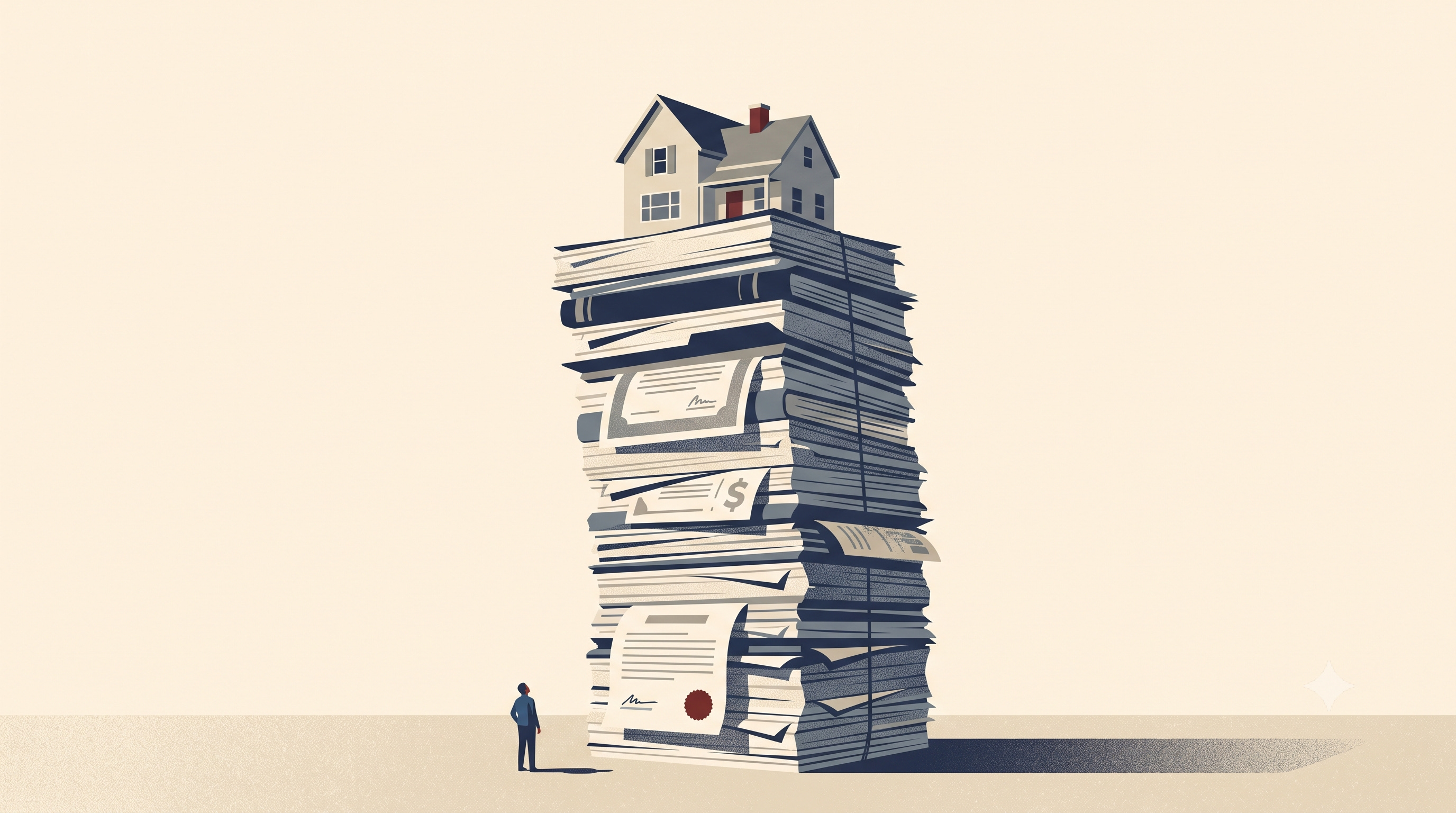
Gambling on Real Estate: “But Duncan”, you may say, “the real reason to buy a home isn’t to pay down the mortgage, it’s to participate in the appreciation!” and you’d be right. But this unfortunate gamble creates incredibly perverse incentives.
Given that all the stable cashflows from the property can be leveraged, your equity exposure in a property is the portion that either grows by 10x in a decade or collapses your entire net worth. This leaves most people with a very aggressive posture around real estate. While some aim to mitigate this by paying down their mortgage (which again, is just them buying a derivative), the reality is as long as you own a property a portion of your portfolio is highly volatile real estate equity. While it does have an inflation-mitigating upward bias, as more people ‘buy into’ the mortgage market, it is ultimately dictated by factors in the local economy.
This is where the incentives start to break down. Since the main factors in a local RE market are debt service and the balance of supply & demand, the three ways to increase prices are to increase local wages, increase demand for housing (usually follows increasing wages), or most easily constrain supply. This is where the system begins to become perverse.
Side Note | Cash Buyers: All cash buyers are a fairly recent phenomenon that appear to be contrary to this whole thesis. However, I think that we have reached a critical mass where mortgage availability already dictates the baseline price so an eager buyer, with the liquid resources, is still needing to beat out a mortgage borrower. This ultimately just means that these all-cash buyers are still effectively taking the derivative on the mortgage market, with the added equity risk that mortgage-fueled prices will eventually catch up or another all-cash buyer will be around to catch the knife.
Constraint of Housing and the Brewing Economic Crisis
Given the gamble on housing prices, there is an incredibly strong incentive to constrain housing supply through NIMBYism and regulation, an issue that we see every day in California. Ultimately these constraints will push real estate prices to the maximum price that the local labor market can endure. This is especially perverse in a state like California where there is no additional property tax levied on homeowners who enjoy rapid appreciation.
This extraction of economic rents from the local labor market, places a serious burden onto the competitiveness of industry. In the short/medium term, this pressure will result in a labor force that demands higher wages to service the existing stock of businesses, however over time this wage pressure reduces ability to attract capital and compete in the global labor market resulting in firms closing down or moving operations. This creates a stagnant local market where real productive capacity is lost due to an inability to compete globally, creating a negative feedback loop that results in the collapse of housing prices. There are no easy wins for real estate investors when value creation can move anywhere.
At the local level, this is painful (but not a crisis) and leads to a market failure like the one we’ve seen in California: people move from a high-cost place to a lower-cost place. However, on the national stage, and this is a national problem, it creates an impossible challenge for American Industry’s ability to compete as they grapple with ever-increasing wages driven ever higher by a growing housing market crisis. Tariffs may delay the crisis by raising the bar for foreign competition, but they can’t solve the underlying issues or make American exports competitive.
Side Note | What keeps me up at night: When we find ourselves in this housing constrained market, most marginal production ultimately finds its way towards the mortgage bond investors, be it indirectly to those who own their own homes (who have been forced to buy their way into the mortgage market), or the banks, financial institutions, and family offices around the world that hold these bonds. This situation suggests that you have only two options: you can either buy out your landlord, sorry… lender, or a large portion of your income will be diverted into the globalized mortgage bond markets, finding its way into someone’s ever-increasing pile of capital. This rapidly starts to look like an unavoidable privatized tax on the American people.
Why Change is Hard
The easy answer to the crisis is always just to build more housing, loosening the market and putting downward pressure on RE prices. However, this ignores that the system desperately wants to uphold itself for two main reasons. The first is what I’ll call “buying in” and the second is because we don’t use gold anymore.
Buying In: The American Mortgage’s “forced savings mechanism”, that economists love to tout, depends on future mortgage buyers (this is the mortgage derivative that we discussed earlier). This means that generations of homeowners have had their primary retirement vehicle in the idea that they can sell their home to someone who will allow them to liquidate their bet on the mortgage market or rent it out (with rents based off the cost of a mortgage). This means that any downward pressure on real estate prices will destroy many retirees’ “wealth”. While any attempt to bail out the next generation from carrying this burden, will lead to a crisis for existing homeowners.
What’s in a Currency? As many gold bugs won’t let you avoid hearing, the US dollar is not backed by anything physical. Many stop here without realizing that the US dollar is upheld by loan obligations, mainly in the form of US Treasuries or Treasury-derived loans, such as mortgages. This means that any attempt to dial back the mortgage market (~$13.2T USD) would put the currency at risk, which is the most basic explanation for why the 2008 financial crisis resulted in bank bailouts rather than homeowner bailouts. This to say, it is unfortunately not as simple as loan forgiveness to offset the losses for homeowners from new construction.
I don’t plan on selling, so this doesn’t impact me: I wish this were true, however since costs are a function of local property prices, you will feel the financial burden from inflation when property prices climb. Further these rising rents on those who haven’t paid off their home, will cause demand for higher wages and worsening competitiveness for the American economy. No matter how much you try to avoid engaging with the financial system, as long as it dictates taxes, real estate prices, and wages you will have to concern yourself with it.
So, What CAN be done?
Before solutions, let's be honest about what this system already is. Americans pay roughly $600 billion a year in mortgage interest, about what every state and local government in the country collects in property taxes combined. The difference is who collects. Property taxes fund schools and fire departments; mortgage interest funds the bondholders, banks, funds, foreign central banks, and everyone who bought in before you. We got rid of feudal rents just to figure out a way to securitized it. So, the question isn’t whether America should have a housing tax, it’s who should collect it.
This leaves us with a clean but painful solution: Property taxes on land. I know, I know, I hate taxes too. But this appears to be the one lever that can compress housing prices without detonating the system, because it redirects the cash flows instead of destroying them.
Since prices are set by debt service capacity, a bigger tax bill eats into what a buyer can service, compressing prices the same way higher rates do; with the exception that cash flow shifts from private balance sheets (the mortgage bondholders) to the public one. Unlike flooding the market with supply, the repricing is gradual, the money stays in the system, demand for mortgage borrowing shrinks, and the currency is protected thanks to the new tax revenue strengthening Treasury credit without interrupting the flow of dollars.
The pain lands exactly where the “buying in” problem lives: on retirees whose home equity is the retirement plan. So, this only works if the revenue is recycled rather than absorbed: income support for the retirees whose exit we just taxed, construction subsidies so building continues even as prices soften, and credits against mortgage principal. The mortgage credits act as forgiveness in slow motion: household leverage moves onto the public balance sheet at a pace the currency can absorb, instead of all at once in the next crisis.
Side Note | Why Specifically a Land Tax: I recently came across a very compelling argument for land taxes over traditional property taxes. Traditional US property taxes are a tax on the value of the overall property. Build a skyscraper? 1% of $100MM. Leave a vacant lot downtown? 1% of $1MM. This linear cost structure indirectly subsidizes low value uses while pushing the burden onto high-value ones. If we allow developers to earn economies of scale on the cost of land, we’ll find ourselves with an incredibly powerful incentive for right-sized development.
What housing provides, ultimately, is a foundation for wealth. It always has. Improve it, and you capture the value you create. Provide it, and you earn the income of a real service. Live in it, and it becomes the stable ground to learn, connect, and build from. Somewhere along the way, we confused that foundation with a purely financial one: buy a house, pay down your mortgage, and retire. Now the bill for that confusion is coming due, and it leaves us a choice: housing can be one more asset for the global capital markets to intermediate, or it can be the stable ground that the next generation builds its American Dream on. The past several decades prove it can't be both.