Back to Insights

Valve isn't the Company you Think

Duncan Young
Read on Substack
Valve isn't the Company you Think

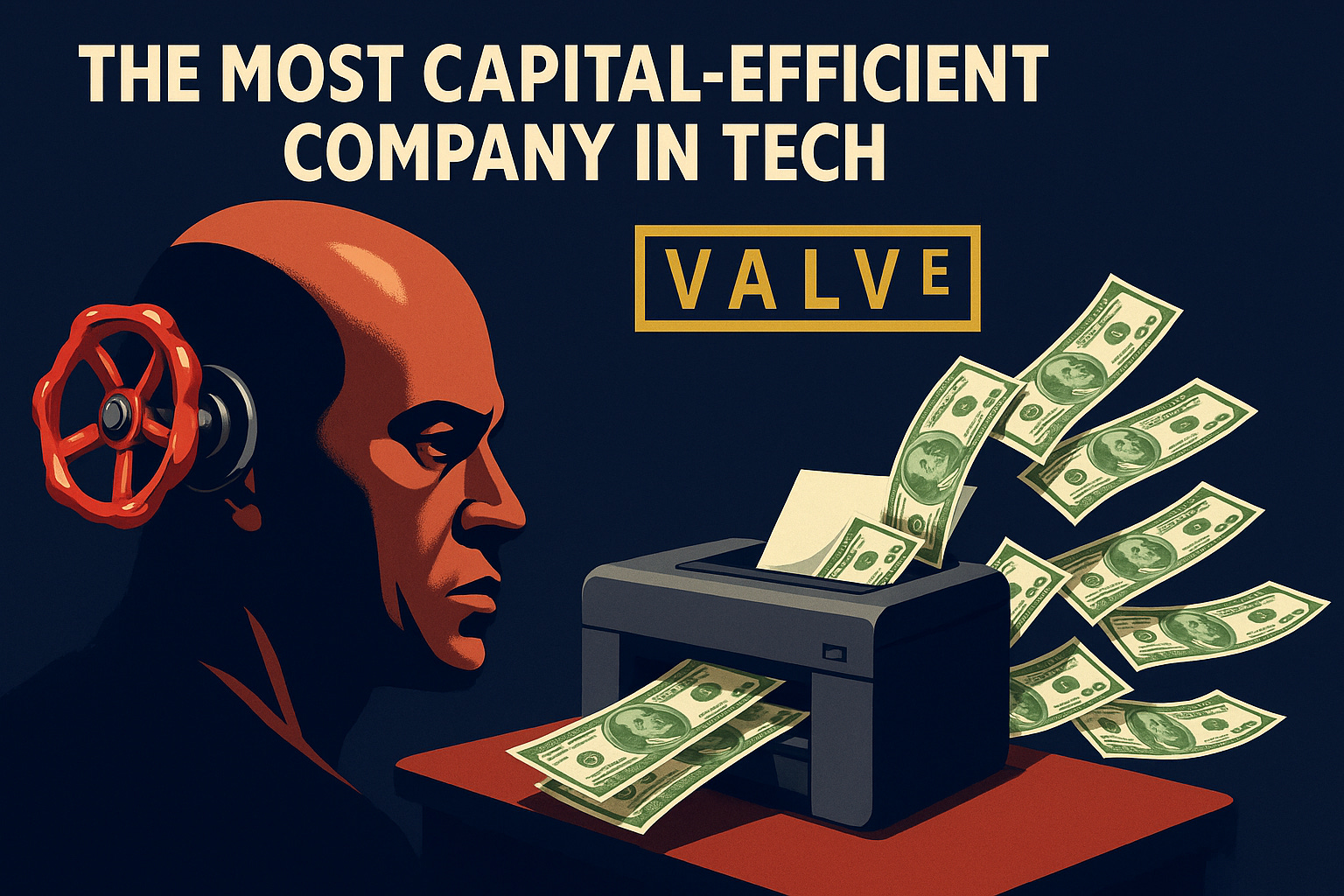
Valve rarely makes headlines or casebooks, but it may be the most well-positioned tech companies today. Valve confidently generates upwards of $25 million in revenue per employee, far outpacing Apple, NVIDIA, and Meta, without raising capital or chasing headcount. By being the de facto one-stop location for PC gamers to connect, buy games, and use mods, Steam’s grip on digital gaming rivals the platform gravity of VISA, Apple’s App Store, and AWS, only with fewer dependencies and far less scrutiny.

Valve isn’t just a game company. It’s one of the purest examples of capital-efficient platform control in the modern economy.

Generated image

I. From Title Launch to Launcher

The first time I built a custom PC, I was 13. The parts came from Newegg. The build came from YouTube. The motivation? I needed something powerful enough to run Team Fortress 2, not for the game itself, but for the marketplace that surrounded it.

That rig would become my Bloomberg Terminal. Not long after, I was arbitraging crate keys and Unusual hats in TF2, flipping cosmetics like a miniature commodities trader. I made well over $3,000 from this hobby, but more importantly I learned more about markets through digital economies than I did in any econ class.

But beneath all that was the real lesson: every trade, every match, every click flowed through one tollbooth: Steam. And behind Steam was Valve.

Founded in 1996 by Gabe Newell and Mike Harrington, ex-Microsoft millionaires, Valve began as a game studio and quickly evolved into something far more powerful. After Half-Life’s breakout success, Harrington exited, leaving Newell as sole steward. Crucially, Valve never raised venture capital, never IPO’d, and has remained fully private. Its transformation into gaming’s core infrastructure wasn’t bankrolled by institutions, it was built from cash flow and user gravity.

Steam didn’t begin as a business line — it started as a defensive patch tool. What it became was far more powerful: a high-margin tollbooth, a developer dependency, and one of the most durable ecosystems in software. Today, Steam controls an estimated 75–85% of digital PC game sales.

What began as a nostalgic game studio evolved into gaming’s most profitable checkpoint. And Valve, with no outside investors to please, became the rare tech company with total freedom to reinvest in its own infrastructure and moat.


II. Control the Map, Control the Match

Steam is not just a store. It’s an economic fortress. Valve takes a 30% platform cut on most games sold on Steam, declining slightly for blockbusters. That’s App Store pricing, but without the developer lawsuits or regulatory heat. It’s pure margin, compounded at scale.

In 2024 alone, Steam generated an estimated $10 billion in software sales, with only ~400 employees. This efficiency comes not from scale, but from platform leverage: developers do the work, Valve collects the toll.

The real magic, though, is in the secondary economies: CS2 skins, Dota 2 cosmetics, Steam Market trades. These are user-driven systems that generate recurring revenue with near-zero marginal cost. Every time a player flips a digital knife or buys an event pass, Valve gets paid. Valve’s cosmetics economy created durable digital scarcity — long before Web3 tried to do the same with token wrappers and hype.

My 15-year-old Steam account holds over $6,000 in games: a sunk cost, but also a social identity. With over 130 million monthly active users and decade-long digital libraries, Steam’s lock-in isn’t contractual. It’s cultural. Beyond owning the customer base, Valve provides the multiplayer infrastructure for game developers, ensuring they remain tied to the platform.

Much like Apple, Valve owns both the rails and the terminal. It dictates the rules of distribution, sets the price for access, and profits from every transaction. But unlike Apple, it does this without hardware lock-in or shareholder pressure. It’s a lesson in how belief systems and switching costs can substitute for regulation.

If this made you rethink distribution, margin, or what a ‘game company’ really is, please share!

Share

Or leave a comment — I'd love to hear how you're thinking about platforms and pricing power.

Leave a comment


III. Open World, Player-Led Collaboration

Valve’s organizational structure is infamous: no managers, no hierarchy, desks on wheels. Employees “vote with their feet” by choosing what to work on. In practice, this creates an internal labor market and emergent capital allocation.

Projects at Valve live and die by peer gravity. If no one wants to work on your idea, it withers. If enough do, it gets resources. This bottom-up model prioritizes creativity and initiative, but it also concentrates informal power among veterans. As ex-employees have noted, there’s no explicit hierarchy, but there are certainly cliques, a kind of shadow management based on tenure and influence.

With salaries set by peer review, it ensures people work on projects with high ambition or clear value. Valve’s comp is peer-reviewed and impact-weighted. There are no titles, but high-leverage projects such as infrastructure and marketplace features tend to be the best compounding bets internally, too.

Still, the upside is immense. Steam, VR R&D, and the Steam Deck were all internal ideas that started without top-down mandates. Valve’s structure isn’t efficient in a conventional sense, it’s not about coordination. It’s about optionality. The company hires like a hedge fund: small, expensive, and deeply talent-dense. Then it lets those people self-organize capital deployment through interest and alignment.


IV. Not Playing for Points

Valve’s war chest gives it the freedom to place long-dated bets without institutional scrutiny. Consider the Steam Deck: a handheld PC designed to keep players (and their game libraries) inside Valve’s ecosystem as form factors evolve. It's not a profit center; it’s a moat extender.

Or VR: Valve has poured years into SteamVR, the Index headset, and Half-Life: Alyx, not for immediate payoff, but to be positioned in case spatial computing becomes mainstream. Even Linux support (SteamOS) and Proton (Windows game compatibility) are defensive hedges against a future where Microsoft locks down the desktop.

Valve’s approach mirrors the logic of a sovereign fund: don’t chase returns, safeguard autonomy. Every new initiative; Steam Workshop, Deck Verified, user reviews, anti-cheat infrastructure, is designed to make Steam harder to leave, not just more profitable to use. Epic Games offered developers 88% of revenue and couldn’t dent Steam’s gravity. Why? Because ecosystems built on identity, community, and sunk cost are harder to displace than those built on price.


V. Built for the Late Game

Valve is a masterclass in patient capital and strategic discipline. It’s never IPO’d. It’s never chased growth for its own sake. It hasn’t released a Half-Life 3 not because it couldn’t — but because it didn’t need to. Steam prints cash. New games are optional.

This restraint has produced one of the most profitable companies per employee in the world. Not because it scaled wildly, but because it owned the choke point. Like a digital Transcontinental Railroad, Valve gets paid for the passage, not the cargo.

And that’s the core lesson: own distribution, reinvest in infrastructure, and avoid any growth that compromises control. Valve’s success isn’t just about games — it’s about capital strategy. It treats talent as an internal market, treats users as allies, and treats optionality as a balance sheet asset.

For investors, founders, and analysts, Valve isn’t just a curiosity. It’s a blueprint. One built not with roadshows or blitzscaling, but with patience, conviction, and the quiet compounding power of infrastructure.


Conclusion: Play Long or Don’t Play at All

Valve’s story defies the arc we’re used to in tech; no IPO, no blitzscale, no exit. It’s a counter-narrative to the venture gospel that says growth must be fast, capital must be external, and management must be layered. Instead, Valve built an empire by ignoring almost all of that. It scaled profits, not people. It built optionality, not optics. And it earned loyalty not through lock-in, but through leverage wrapped in user alignment.

For business thinkers, it’s a reminder that the most powerful companies often look boring from the outside: quiet, opaque, even slow. But beneath that still surface is a compounding engine; platform control, internal markets, reinvested cash flows, spinning without friction.

If this piece sharpened your thinking, consider subscribing or forwarding it to someone building for the long game.

Share

Valve doesn’t need to make noise to make money. It doesn’t need to promise the future to survive the present. That is the power of owning the railways. You don’t need to build the fastest train. Just build the tracks no one can avoid.

If you’re building something; a company, a platform, a fund, and wondering whether to chase attention or compound quietly, look at Valve. It didn’t just play the game. It built the map, set the rules, and then let others fight for leaderboard spots.

Some companies scale to win. Valve scaled to endure.

Subscribe to The Conduit of Value

Get weekly insights on growth, strategy, and business transformation directly to your inbox.

Or visit Substack directly