I’ve got networking on my mind this week: mapping my own relationships and thinking through how network effects build economies of scale. So this week is about networks. But I want to start with a claim that I think most people get wrong:
A network isn’t just a thing that helps your business. It’s compounds value at every scale you operate at, the relationships you personally hold, the demand a business can sit on top of, and the region a company chooses to plant itself in.
To build on this these we’ll start on the Micro and move towards the Macro.
1. Your Network: Opportunity Surface Area
As a young entrepreneur, I’ve opted to trade cash for trust often, recognizing that the fastest compounding, untaxable investment I have is my network. The reason? I want to maximize my Opportunity Surface Area. (Selfishly, I also enjoy interesting conversations with brilliant people.)
My framework starts with an economic network: a series of interconnected nodes that exchange information, resources, and trust among people and companies. When I say node, I just mean one person or company existing out in the fabric of trust and relationships that underpins trade and business.
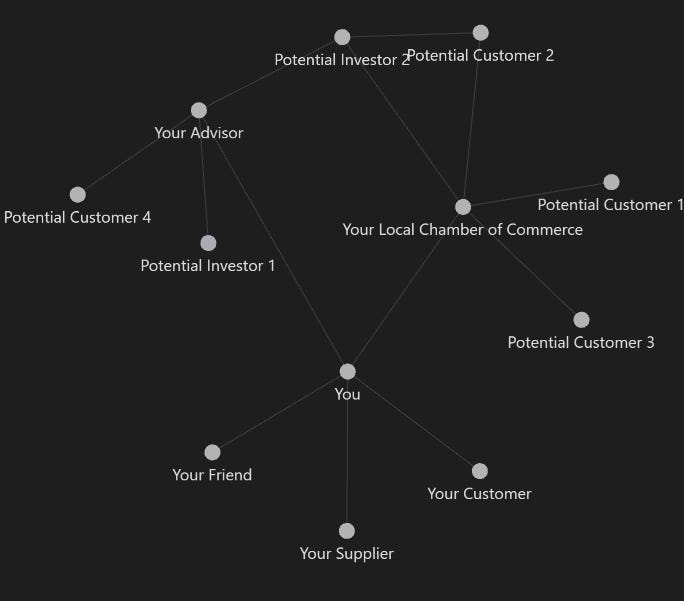
Existing networks of trust dictate the likelihood of someone engaging with your product or service. By appearing on the periphery of my network — say, two nodes away — I can rely on the trust in my existing network as a strong signal that engagement is likely to end positively.
But trust decays, usually starting to break down once you get more than two nodes out. So your Opportunity Surface Area is the surface area of the nodes within two connections of you: the people who may have business opportunities, capital, expertise, or a willingness to freely discuss economic opportunity with you or with your first-order connections (who are, in turn, likely to share it with you).
Super Connectors
Here’s a concept I came across a few years back: your friends have more friends than you. The Friendship Paradox, in short, says that people with many friends are connected to many people, which creates a sampling bias — any given friendship is more likely to be with one of these high-connection people.
I call that high-connection person a super connector: someone with a very large network who also benefits from interconnecting it.
A few careers tend to reliable produce them: a good BD-focused banker, the head of a chamber of commerce or similar economic development body, a conference organizer, a community builder. The value of stacking these people into your network is that it drastically expands your Opportunity Surface Area.
Run the math: if the average person has 10 relevant business connections, your Opportunity Surface Area is around 110, your 10 connections, each with 10 of their own. But add just 5 super connectors with, say, 100 relevant connections each, and that number jumps to 615.
That’s still a small network in absolute terms. The point is the density of super connectors. And real networks overlap heavily, which cuts both ways. Two super connectors in the same town and industry probably share 50–80% of the same network. That overlap buys you trust density into any new connection — but it also caps the size of your surface area. The way to fight that is to build isolated networks: connections in different towns or industries, where you capture the full size of your surface area instead of the overlap. The tradeoff is that the depth of your relationship with the initial connection now matters far more.
Coming from the investor business development side, I’ve found that economic developers are some of the most underrated sales superpowers in the world. Build a genuine connection with a few of them and then incentives kick in. Their organizations exist to bring value to their members, so clearly and honestly communicate how you do that and then stay in touch, check in often, and contribute for free when you can (basically be a genuine value add, not purely sales oriented). Then when they hear about a problem that your firm solves, they will think of you first and make the introduction. This is how I’ve gained over half of my client base.
2. Businesses Built on Networks: Aggregating Demand
Scale up one level. Some businesses don’t just use networks; they exist because of, on top of, or alongside one. The obvious examples are Uber and Airbnb — valuable because everyone else uses them — but the same dynamic shows up across industry. The thread is the same as Opportunity Surface Area, just at the firm level: value concentrates where connection concentrates.
Conference organizers. People and businesses in the same industry share the same problems, questions, and concerns. A conference organizer aggregates that industry to increase vendor exposure, create connection, and circulate solutions among similarly focused professionals. It only works because they can aggregate the demand of an industrial network into a critical mass where a business of connection becomes viable.
Community organizations. Same logic. These sit on top of an existing network, deepen engagement, expose the network, and provide an aggregated way to participate in it. My favorite example is a well-run chamber of commerce: it collects memberships from businesses in a community, positions itself as the center point of that network, and from there it provides value by collecting marketing sponsorships, hosting events, and wining grants.
Lobbying firms. For better or worse, the western world — and the US in particular — is increasingly oriented around government intervention: protectionism, subsidy, anti-competitive regulatory hurdles that keep otherwise broken markets stable. A single policy or budget allocation can lift an entire industry, creating opportunity for those willing to head to Washington. It’s rarely economic for one firm to advocate for structural changes in policy or spending on its own — but when the benefit accrues to a whole industry, a membership-based organization can aggregate that demand and sell lobbying as a service.
Here's what these all have in common: each one is a super connector with a corporate structure built around it, an institution whose entire job is keeping a dense network in one place. That gives you two options. The simple one is to get inside a network someone else already built: sponsor the conference, join the chamber, take the membership, and borrow its surface area as your own. The harder one, and one that builds a business of its own, is to find an industry whose demand nobody has organized yet and make yourself its center point.
3. Industrial Clustering: Networks at Regional Scale
The largest scale. Industrial clustering is one of my favorite concepts in economic development: when many similar businesses concentrate in one geography, they create more robust markets for both inputs and outputs, everything from labor to industrial process.
The labor-market version is familiar: California has a hard-to-replace ‘natural resource’ of technical talent, clustered through decades of innovation. That depth extends past engineers to lawyers who’ve papered thousands of Series As, investors who understand moonshot risk, and bankers fluent in venture capital dynamics — a structural advantage for tech, much like New York’s in finance.
But the version I find more instructive is the manufacturing cluster, because it shows how clustering creates new businesses that couldn’t otherwise exist.
When a CNC machine cuts metal, the chips come out covered in coolant and lubricant, which makes them hard to recycle. Cleaning them economically requires a centrifuge or wash station, which requires scale. A single small shop can’t justify that equipment, so it can’t sell its scrap. But put many producers in one area, and a third-party chip-cleaning operation suddenly becomes viable. That business improves everyone’s margins slightly, which improves the whole cluster’s competitiveness. It also lets the cluster capture vertical integration efficiencies while staying fragmented — and fragmented ownership arguably outperforms a paid employee running the same line as an internal cost center.
Repeat that across 10,000 tiny operational improvements, and you eventually have an impassable moat.
Closing
Ultimately, networking is a foundational layer to economic activity. Markets exist because of networks of buyers and sellers, so in business, networks quickly become the thing you see once and then can't stop seeing everywhere. Every commercial relationship, industry organization, and local competitor has some function of network effects underlying them, if you know where to look. If you want to expand your network surface area with other investors, operators, or founders, please send me an email (Duncan@saorsapartners.com), I always enjoy meeting new people!
For more on this topic, I highly recommend The Cold Start Problem by Andrew Chen of A16Z, thanks for the suggestion!