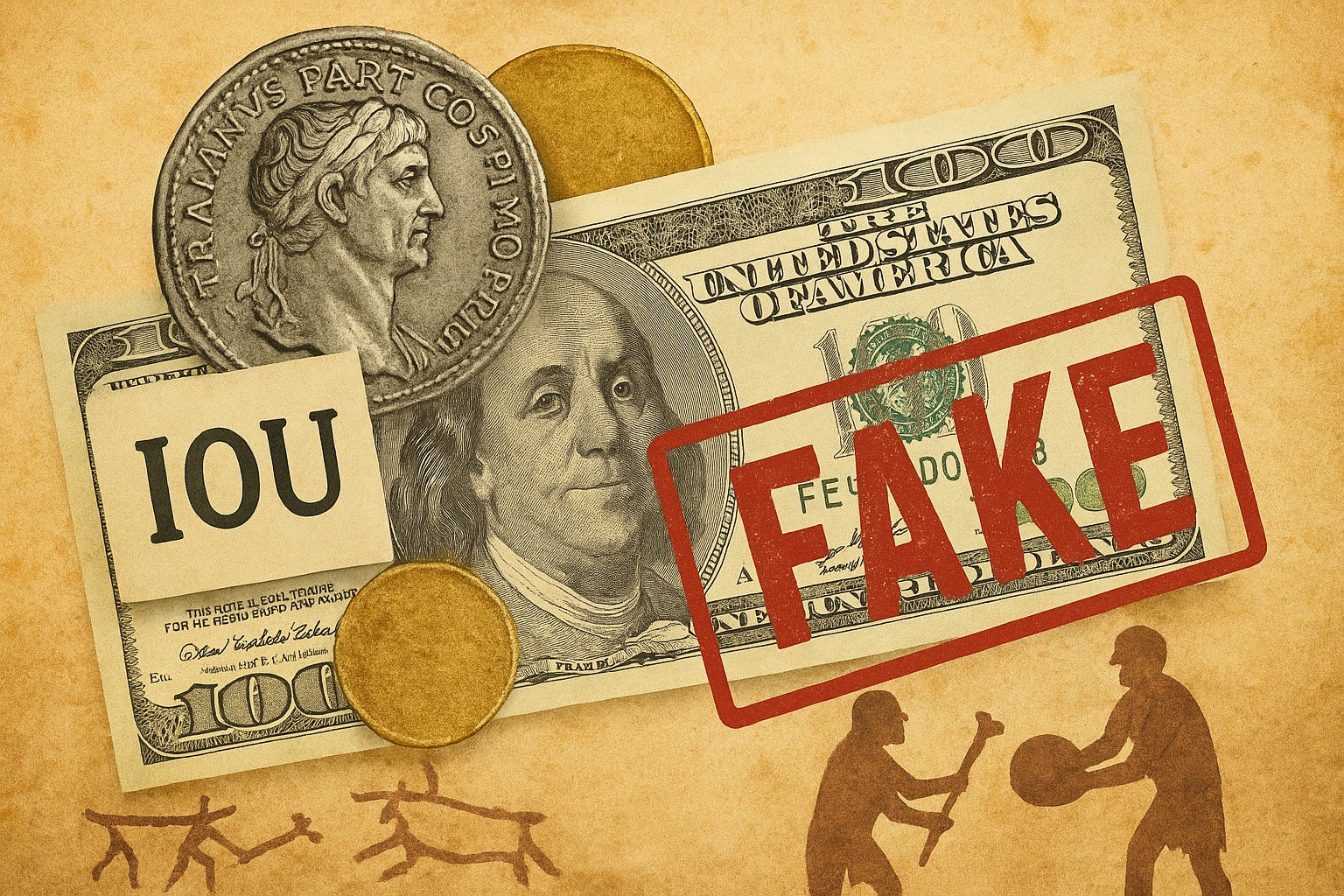
My favorite saying, something that those who know me hear too often, is: “Money is Fake.”
I promise this isn’t the start of a manifesto, but it stands that Money is a vague idea that appears simple at first and makes less sense the deeper down the rabbit hole you go.
Well, then What is Money?
Classical economics will tell you that money is essentially three things:
A Unit of Account - This is as boring as it sounds, it just means that you can easily count things using it as a standard unit. For example, the average house in San Francisco is hovering at $1.3MM USD, whereas the Hazy IPA I drink to forget that fact is $4 USD. Money can help us with comparisons!
A Medium of Exchange - As you sit at your computer on the workday and clatter away at spreadsheets, you are generating value for your company. Money is the conduit that allows you to translate that Excel masterpiece into an unclogged toilet from your friendly neighborhood plumber. You can exchange Money for goods and services with other people without directly trading a spreadsheet for a plunger.
A Store of Value - For this all to work outside of a fixed point in time, money has to have a persistent and relatively stable value. Money doesn’t work very well if it swings in value by 50% every other year - I’m looking at you Bitcoin…
While this definition is robust, there are so many great fringe cases. Let’s hit on some historical context to help to digest the source of money and you’ll start to see why things start to get fuzzy.
Money came from Debt, not ‘Barter’
There’s some solid arguments from the academic community that you probably learned in your Economics class about the origins of Money:
Cave Bro 1: Me want mammoth steak. Me trade you big rock.
Cave Bro 2: Bro, me no need rock. Me need spear for Tinder date hunt.
Cave Bro 1: But me big rock real nice…
Cave Bro 2: Ugh, this always happen. Barter dumb. Me tired of weird trades.
Cave Bro 1: What if we use same thing for all trades? Like, shiny yellow rock?
Cave Bro 2: Work for me, but take yellow rock next time trade or I use big rock next time.
This idea — that people created money to simplify barter — feels intuitive. But it might not be how things actually started.
In fact, there’s some great literature (shoutout to David Graeber) that flips this origin story on it’s head — arguing that money came from credit, not from a shiny rock economy.
Cave Bro 1: Me hungry. Got no steak.
Cave Bro 2: Me just hunt. What you got?
Cave Bro 1: Me give you mammoth rib next hunt.
Cave Bro 2: Hmm. Tribe small. Me remember. You owe me one.
Because early communities were small and everyone knew each other, trust-based IOUs were more likely the norm. No need for coins — just social credit.
While trade certainly occurred between different groups of early people, it’s seems more likely that they didn’t use money at all and just traded when there was a double-coincidence of wants.
But what happens when the community gets too big for everyone to remember who owes what? Enter the middleman… or middle brother?
Dealing with Strangers
In a larger village of a few hundred people, there’s no certainty that everyone trusts each other, let alone knows each other. One solution is having a mutual friend who’s trust you can trade on - after all, your friends have more friends than you - for example:
Luigi: Hey mind if I owe you one for that Mushroom?
Toad: Weird Green Man, I don’t even know you, pay up or get out.
Luigi: My brother Mario owes me a favor, in fact he wrote it on this paper, if you trust him, you can take it!
Toad: Mario? Love that guy! You can take the mushroom as long as you get out of my shop.
Now we have a more scalable Money, leveraging someone else’s trust to deal across a larger community.
I think of the Roman Empire on a Daily Basis
I am not immune to the plague of the modern man, I find myself thinking of the Roman Empire more often than I would like to admit. For me, of course, it’s mainly the economic aspects. I want to show you that there’s a reason those Emperors stamped their faces on coins — and it wasn’t just vanity.
In a larger city or community that isn’t based on a plumber jumping on people’s heads to “repay” his debts, it’s essential that we trade off of a centralized figure’s trust. For example a leader of a village may issue IOUs to various villagers. Since everyone knows and trusts the leader, people can use IOUs from the leader to trade amongst each other.
Now the only way the leader reaches a point where he has enough outstanding obligations is that he has a very large debt to the village that he may need to settle in the future. But relying on personal IOUs breaks down once the community scales or the leader croaks. That’s where taxation steps in — turning trust-based IOUs into enforceable obligations.
With taxes, the leader flips the ledger. Instead of owing people, he issues tokens (maybe shiny coins with his mug on them) when people contribute to the community — like building a road or more likely, fighting his war. Then, at year’s end, everyone has to pay one token back — or face exile. This tax acts like a sink — pulling money back out of circulation and maintaining its scarcity and value, and avoiding the leader’s trust losing value.
Now the money has value not because of the metal, but because the community (or the king) agrees: you need it to stay in.
So What is Money, Really?
It’s not rocks. It’s not gold. It’s not even the paper in your wallet or the numbers in your bank app. It’s not even really ‘just taxes’.
Money is a Conduit of Value that Depends on Trust.
It’s collective make-believe: a social technology that has helped us collaborate, go to war, build civilizations, and drive innovation.
The closer you look, the stranger it gets. Money is fake — but the powerful kind of fake. A social phenomenon built on relationships and sustained by our trust in people and institutions: banks, governments, and markets.
That trust can be earned, manipulated, or broken — which is why currencies rise, collapse, or disappear. And in a world where trust is increasingly fragile, remembering that money is a story might be the only way to know when the plot is about to change.
We treat it as real because we have to. But if we forget that it’s invented, we stop asking the most important question: Who Is This Story For?
If money is trust, then every transaction is a vote — not just for what we value, but for the story we’re looking to write.
Author’s Note
Alrighty - first post on Substack, that was fun! I am going to keep writing these and posting per the recommendation of my good buddy Max after a great coffee chat we had today. I love learning about money, history, economics, businesses, and understanding how we react to incentives - It’s made all the better sharing with people!
I hope my perspective helps you cut through the noise of the system we’ve found ourselves in to see the freedom and humanity that underlies the increasingly financialized world around us.


