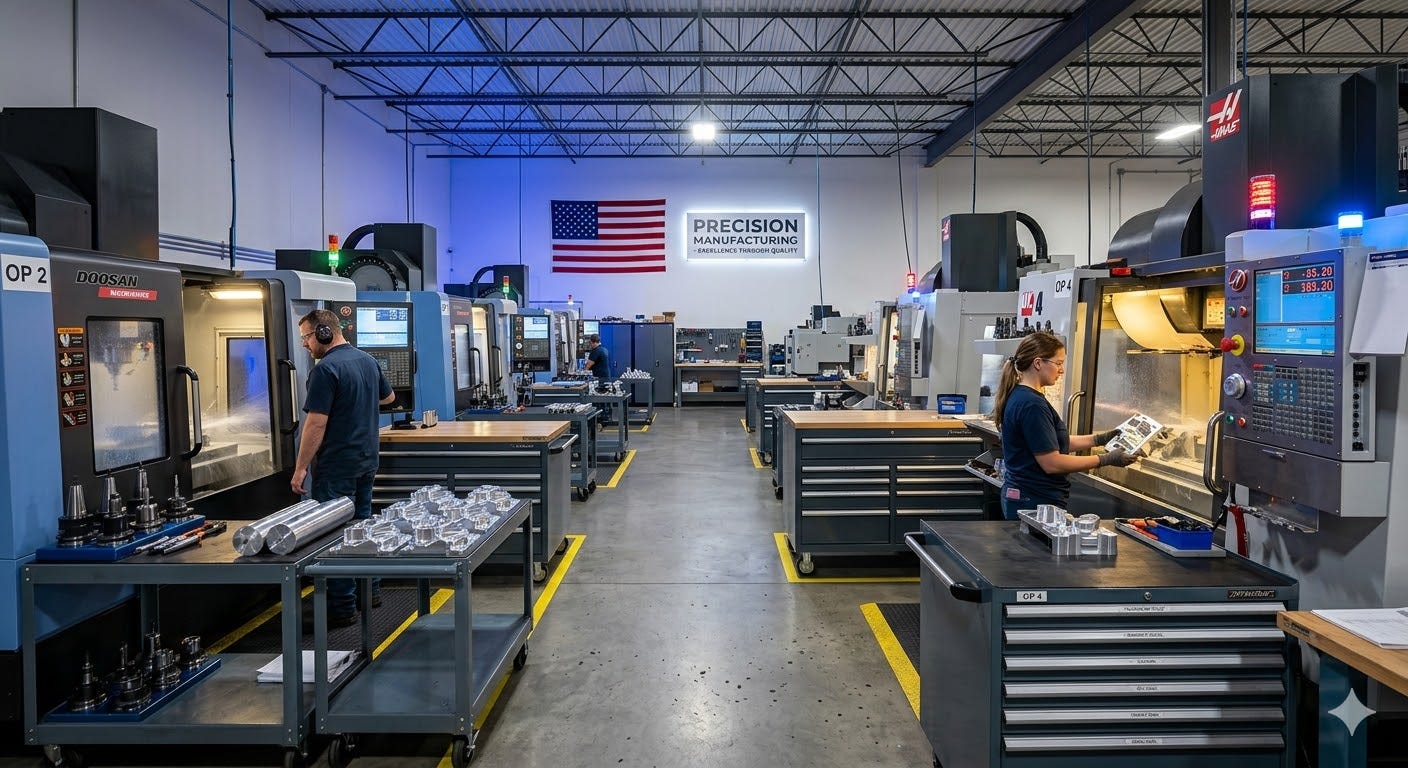
I was in St. George, Utah this week, and I walked into a manufacturing facility that stopped me cold.
Thirty employees working in a space designed around their craft — real equipment, American-made, every inch of the floor earning its place. A decade of patient building. No outside investment, no debt, no venture deck. Just a founder who came from nothing, had a clear picture of the operation he wanted to build, and spent ten years making every decision in that direction. He onshored his production. He reinvested everything back into the floor. His team tenure is nearly zero turnover. He told me he leaves money on the table regularly — not out of ignorance, but out of philosophy. When everyone around you thrives, you get the best outcomes. He figured that out before most MBAs have been alive.
The business is growing north of 50% a year.
I left wondering why that story feels so surprising, I mean it shouldn’t. It used to be the default.
When I started my firm, I named it Saorsa, a Scottish Gaelic word for freedom. The name was deliberate. I believe the purpose of building a business is to create something that expresses who you are while genuinely serving other people. When you add value, you justify your consumption. The business becomes a form of self-expression that other people can join — your employees, your customers, your community — each participating in something that compounds outward. That’s what the St. George operation was doing. That’s the type of company I set out to work with.
I came to that belief after spending years on the other side of the table.
I worked in private equity and invested in venture capital deals long enough to understand how the machine works, and to respect it. Capital at risk deserves a return, and the system produces genuinely world-changing outcomes. No disagreement there.
But here’s what I kept watching: the shape of venture capital, high-return, fee-intermediated, compressed time horizon, necessitates an extractive growth trajectory whether anyone intends it or not. The incentive isn’t to build the best company. It’s to build the best exit. And when that capital touches a founder who doesn’t know how to speak its language, let alone use it, things go sideways in a very predictable way. Modest, mission-driven companies get swept up in a rate of acceleration that their culture, their team, and their purpose can’t survive. By the time a company reaches a Series B, product-market fit isn’t the question anymore, the question is whether the machine can scale fast enough to justify the capital structure, and the answer is often that it can’t without breaking something important. Companies become the thing they set out to destroy. Nobody in the room is exactly wrong — the founder wanted to grow, the capital wanted a return — but the tangible outcome is one that none of the people building actually wanted.
That’s not a capital problem. It’s a clarity problem.
HumanScale is my attempt to name something I’ve been circling for a while.
Early economies were highly localized. Capital was allocated close to home, by people with long time horizons and real skin in the game. Production was close to consumption. The craftsman knew his customer. The merchant knew his supplier. That proximity created natural constraints that also happened to produce better outcomes: more durable businesses, more resilient communities, more trust in the system. That model of capital — long duration, mission aligned, grounded in relationship rather than return — still exists. It's just not the one LinkedIn celebrates.
We can still build that way, and not because nostalgia is a strategy, but because the underlying economics are sound. A $10 million manufacturing operation in St. George, Utah, run by someone who loves their craft and their customer, is a more stable wealth-creation vehicle than a $50 million venture-backed company grinding toward the next raise. A software business with 10,000 loyal customers and 60% margins is more valuable to the founder, the team, and the surrounding community than the same company stretched thin trying to justify a cap table it didn’t need.
Unchecked growth creates extractive systems. It erodes trust at every layer — with employees, customers, and partners. It converts founders into fundraisers and turns people into headcount. There’s also a subtler cost: it makes the world less interesting to live in, because it produces sameness at scale rather than character at a human level.
The question I keep asking: why can’t we have a few $10 million manufacturing operations, software tools, and niche global lifestyle brands in every community? Why can’t 50 million small business owners do what they love, serve 10,000 customers each, and build real financial independence without ever touching a term sheet? That’s a more interesting society than the one the venture playbook is building.
There’s a threshold where this starts to break, and I’ve felt it in my own work. Somewhere around $25 million in revenue, something shifts. You need HR infrastructure to manage people rather than know them. Decisions get made by process rather than judgment. Systems start requiring people to operate them rather than people being required to build systems. The intimacy that made the thing worth building quietly exits the building. Some businesses genuinely need to be bigger. But most don’t, and most founders scaling past that number are chasing a narrative someone else wrote for them. The ones who do it right compound their culture the same way they compound their capital, on their own terms, at their own rate.
The VC narrative is genuinely brilliant at one thing: capturing young ambition and maximizing its output. And to be clear — opting into that system is a legitimate choice. Running fast can be exhilarating, and when the roulette lands on green it's one of the most powerful wealth-building machines ever designed. The unicorns are real, but they outshine the wreckage beneath them. For every founder who exits at nine figures, there are dozens who spent five years fighting to raise their next round, burning out their team, diluting their mission, and running a sprint they never wanted to run.
The founder in St. George didn’t need that story, he wrote his story on his terms, at his pace, and maintained his vision all the way through.
HumanScale is an argument for a different default. Not against ambition, the founder I visited is one of the most ambitious and brilliant business owners I’ve met. Nor against growth, he’s growing faster than most venture-backed companies in his category. It’s an argument against using capital and scale as a substitute for clarity about what you’re actually building and why. We don't need more capital chasing returns. We need more capital that gives a damn about what it builds.
If you know how much it costs to acquire a customer, how much you make from that customer over time, whether you’re selling something they genuinely love, and whether the business can sustain that love as it grows — you can build something real. Something that lasts. Something that actually produces the freedom you thought you were signing up for when you started.
That’s what I want to work on. That’s why I’m building.
If you’re building and want the ongoing thread — subscribe to Conduit of Value. Future pieces in the HumanScale series will go deeper on specific questions: how to know when you’ve hit your right scale, how to structure for durability rather than exit, how to use capital intentionally without letting it use you.
If you’re a founder somewhere between “this is working” and “I’m not sure it’s working in the right direction” — I’d genuinely enjoy the conversation. Not a sales pitch. Just the kind of conversation that gets me out of bed in the morning. duncan@saorsapartners.com
And if you're a local investor, a community lender, a family office, or simply someone with capital and a longer time horizon than a fund cycle, you're part of this conversation too. The founders I'm describing need patient capital from people who care about the outcome, not just the multiple. If that's you, reach out. The world gets more interesting when money and mission point in the same direction.